How the Search for Identity Can Distract Us from Christ
Key Scripture: Isaiah 29:16
“You have turned things around,
as if the potter were the same as the clay.
How can what is made say about its maker,
“He didn’t make me”?
How can what is formed
say about the one who formed it,
“He doesn’t understand what he’s doing”?” — Isaiah 29:16 (HCSB)
During my quiet time recently, I found myself contemplating an expression we hear so often in Christian circles: our identity in Christ.
What does this really mean? And what does Scripture actually teach us about who we are?
As I began searching the Scriptures and exploring where this language originated, something struck me.
The word identity, as we understand it psychologically today, is a modern concept. It is not part of the original biblical vocabulary.
The English word emerged around the sixteenth century, originally referring to sameness or oneness. Its modern psychological meaning developed much later.
This discovery led me down an unexpected path. I began wondering how humanity’s understanding of the self had evolved over the centuries, and whether these changing ideas had unknowingly influenced the way we understand our relationship with Christ.
And a rather uncomfortable question began forming in my heart.
Have we become so accustomed to borrowing the world’s language for understanding ourselves that we no longer recognise when the world’s assumptions have entered our understanding of discipleship?
From the Creator to the Self
The Bible begins with God.
Genesis 1:26–27 tells us that humanity was created in His image. We did not bring ourselves into existence, nor were we created to live independently of Him or in isolation from one another.
Colossians 1:16 reminds us:
“For in him all things were created: things in heaven and on earth, visible and invisible, whether thrones or powers or rulers or authorities; all things have been created through him and for him.”
Through Him. And for Him.
Yet throughout Scripture, we encounter humanity’s recurring struggle between dependence upon God and the desire for self-rule.
As I traced the historical development of our understanding of the self, I noticed how the emphasis gradually changed.
Early Christian thought: Augustine, writing in the fourth and fifth centuries, examined his desires, struggles and inner life. Yet his inward examination directed him towards repentance, worship and knowing God. His heart found its rest not within himself, but in his Creator.
The Enlightenment: René Descartes, a professing Catholic, famously declared, “I think, therefore I am.” John Locke, who also professed Christianity, later explored personal identity through consciousness and memory. Their philosophical inquiries made the thinking, conscious self an increasingly important subject of investigation.
Romanticism: During the eighteenth and nineteenth centuries, greater importance was placed upon individual feelings, personal experience and authenticity. Discovering and expressing one’s inner self became increasingly influential.
Modern psychology: Wilhelm Wundt established experimental psychology as a scientific discipline. Sigmund Freud sought to explain human behaviour through unconscious psychological processes, while Erik Erikson popularised the concepts of identity formation and identity crisis.
These theories were not founded upon biblical revelation. They sought to understand humanity through observation, consciousness, behaviour and psychological development, rather than beginning with the biblical account of humanity’s relationship with its Creator.
Psychology can offer useful insights into human behaviour. But can it explain why humanity was created, our need for redemption, or the transforming work of the Holy Spirit?
(This raises an important question: If these frameworks were developed without biblical revelation as their foundation, have we carefully examined their underlying assumptions before incorporating them into Christian teaching and discipleship?)
Postmodernism and expressive individualism: Contemporary Western culture increasingly emphasises personal authenticity, self-expression and individual choice. Although expressive individualism has roots in earlier modern thought, its emphasis upon discovering and defining oneself has become deeply embedded in our culture.
The message is familiar: look within yourself, discover who you are and determine your own path.
Do we see what is happening here?
Over the centuries, humanity has increasingly come to be understood through frameworks that do not necessarily begin with the Creator.
Yet Scripture tells us that we are made in God’s image, created through Him and for Him, and that our new life as believers is found in Christ.
Have we become more enamoured with ourselves than with the very God who created us?
And more troubling still, have we unknowingly carried this self-centred understanding into our Christian faith?
When Culture Begins to Shape Our Faith
As I reflected upon this, I began to realise how subtly cultural ideas can influence our understanding of biblical truth without our even recognising it.
The danger is not always an outright rejection of Scripture. Sometimes it is the gradual acceptance of ideas that sound familiar, encouraging and even Christian, while carrying assumptions that are not rooted in God’s Word.
We may begin speaking about love without holiness, grace without repentance, purpose without surrender, and blessings without obedience.
We celebrate our gifts and potential, but how often do we contemplate what it means to deny ourselves, take up our cross and follow Jesus?
This brought me to an even more troubling question.
Have we become so accustomed to a culturally adapted Christianity that we would struggle to recognise the difference between the gospel Jesus preached and the version of Christianity we have become comfortable with?
When I read the Gospels, I encounter Jesus preaching repentance, confronting hypocrisy, warning about sin and judgement, and calling people to follow Him at considerable personal cost.
Yet He also demonstrated extraordinary compassion, forgiveness and love. His grace and His call to repentance were never in competition.
Paul warned Timothy:
“For the time will come when they will not tolerate sound doctrine, but according to their own desires, will multiply teachers for themselves because they have an itch to hear something new. They will turn away from hearing the truth and will turn aside to myths.” — 2 Timothy 4:3–4
And Jesus rebuked religious leaders for allowing their traditions to displace God’s Word:
“You revoke God’s word by your tradition that you have handed down. And you do many other similar things.” — Mark 7:13
The Word of God has not lost its power. But when its message is selectively presented or distorted, we risk losing sight of the very truths through which God calls us to repentance and transformation.
A Sobering Reality in Europe
The decline in Christian affiliation across Europe also gives me much to reflect upon.
According to Pew Research Center, Europe’s Christian population declined by approximately 9% between 2010 and 2020.
In the Netherlands, the Protestantse Kerk in Nederland recorded a net decrease of 43,000 registered members during 2024. In Germany, the Evangelical Church in Germany (EKD), comprising predominantly mainline Protestant congregations, reported approximately 350,000 formal departures in 2025.
These figures alone cannot tell us why every person has left.
Yet a Dutch article on stille kerkverlating (quiet church departure), published in Magazine Onderweg, raised an uncomfortable concern: when Christian communities become increasingly indistinguishable from the surrounding society, people may struggle to recognise what makes belonging to them different.
I find this deeply troubling.
Have we confused making the gospel understandable with changing it to make it acceptable?
Jesus called His followers to be salt and light (Matthew 5:13–16).
But what happens when the values of the world increasingly shape our understanding of Christianity rather than God’s Word transforming our thinking?
The danger is not merely that we have borrowed the world’s vocabulary. It is that we may have borrowed the worldview behind that vocabulary and then used Scripture to give it Christian legitimacy.
When the Self Takes Centre Stage
As I continued reflecting, Paul’s warning in 2 Timothy 3:1–5 came to mind.
He speaks of perilous times in the last days, beginning with these words:
“For men shall be lovers of their own selves…” — 2 Timothy 3:2 (KJV)
The Greek word philautoi means lovers of themselves.
Paul goes on to describe pride, arrogance and the love of pleasure more than God, even while maintaining an outward appearance of godliness.
What a sobering warning for a culture increasingly preoccupied with discovering, promoting and expressing the self!
Selfishness was already a danger among the earliest believers, so this warning is not unique to our generation. Yet its relevance to contemporary thinking is difficult to ignore.
The danger is not that we possess an individual self. It is that the self begins to occupy the place that belongs to God.
“Let This Mind Be in You”
And then consider Paul’s instruction in Philippians 2:5:
“Let this mind be in you, which was also in Christ Jesus.” (KJV)
What was this mind?
In the preceding verses, Paul calls believers to abandon selfish ambition and conceit, walk in humility and consider the interests of others.
He then points to Jesus Christ.
Though Christ was in the form of God, He humbled Himself, took the form of a servant and became obedient even to death on a cross (Philippians 2:5–8).
Jesus did not cease to be God or lose His divine worth. He willingly humbled Himself in obedience and sacrificial love.
And Paul calls us to have this same mind, not merely as an individual spiritual ideal, but as the attitude that should shape how we relate to one another.
The early believers demonstrated this shared life through their devotion to teaching, fellowship, prayer and caring for those in need (Acts 2:42–47).
Acts 4:32 describes them as being of one heart and one soul.
They were not perfect. The apostles confronted selfishness, division and pride among them. But these were attitudes to be overcome, not celebrated.
And this brings me to a truth I find deeply humbling:
We were not created to live independently of God, nor redeemed to become isolated individuals pursuing personal significance. We were brought into the body of Christ, called to love and serve one another under His lordship.
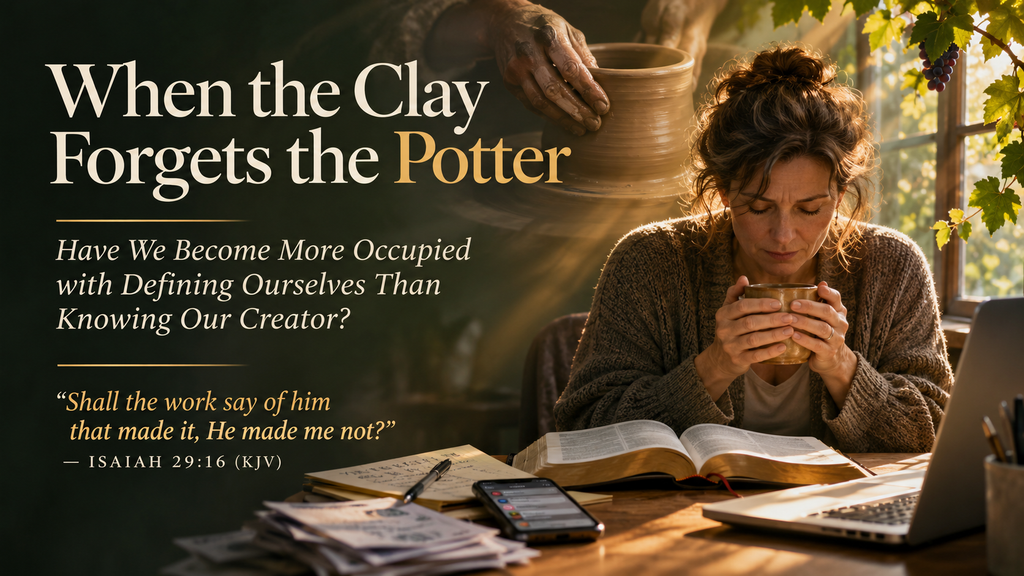
We Are the Clay, Not the Potter
As I returned to Isaiah 29:16, something became increasingly clear.
God was confronting His people’s tendency to turn things upside down, acting as though their plans could be hidden from Him and questioning His understanding.
The created had begun to presume upon the authority of the Creator.
The same warning appears in Isaiah 45:9:
“Woe to the one who argues with his Maker—one clay pot among many. Does clay say to the one forming it, ‘What are you making?’ Or does your work say, ‘He has no hands’?”
God is the Potter.
We are the clay.
Yet how often do we approach Him with our ambitions and expectations, asking Him to bless the lives we have already planned?
How often do we insist upon our own understanding, forgetting that we belong entirely to the One who formed us?
And is this not the very danger of a self-centred understanding of life? That we begin to assume the authority to determine what we ought to become, while expecting our Creator to affirm our decisions?
In 2 Corinthians 4:7, Paul describes believers as earthen vessels carrying an extraordinary treasure, so that the surpassing power may clearly be recognised as God’s rather than ours.
The vessel is not the treasure.
God is!
We are instruments in His hands, called to surrender ourselves to His purposes. Our worth comes from our Creator, but the authority and glory belong to Him.
And this led me back to the words of Jesus.
“Apart From Me You Can Do Nothing”
“I am the vine, ye are the branches … for without me ye can do nothing.” — John 15:5 (KJV)
Jesus does not instruct His disciples to discover themselves or establish their personal significance.
He calls them to abide in Him.
A branch cannot produce fruit through determination, self-awareness or personal ambition. Its fruitfulness depends entirely upon remaining connected to the Vine.
The Greek word menō, translated as abide or remain, speaks of continuing and remaining.
As I contemplated what it truly means to abide in Christ, I was reminded of Isaiah 40:31, where those who wait upon the Lord are promised renewed strength.
The Hebrew word qavah, translated as wait or hope, has a fascinating connection to the imagery of a rope, where individual strands are twisted and bound together.
What a beautiful picture of our dependence upon God!
Imagine bringing a weak, fragile strand and intertwining it with one that is infinitely stronger. The weak strand does not suddenly become strong in itself. Rather, it becomes bound to a strength far greater than its own.
It is as though God is inviting me, “Come, bring Me your weakness. Entwine it with My strength. Stop striving to become strong in yourself. Remain in Me, and receive My divine power in exchange for your weakness.”
The Hebrew word chalaph, translated as renew, carries the sense of change or renewal.
What a beautiful picture of a divine exchange!
I bring Him my weakness, and in exchange, I receive His divine power. Not strength that originates in me, but His power made evident through my weakness.
For He is the One who gives power to the faint (Isaiah 40:29).
And so I can mount up with wings like an eagle, run without growing weary, and walk without fainting. Not because I have become stronger in myself, but because I am now utterly reliant upon the inexhaustible power of the One who never grows weary.
Is this not also the very essence of abiding in Christ?
Just as the branch draws its life from the Vine, I draw everything I need from Him. The branch does not strive to manufacture life or fruitfulness. It simply remains in the Vine, allowing His life to flow through it.
Abiding is not about becoming stronger in myself. It is about bringing my weakness into complete dependence upon His strength, remaining in Him, and allowing His divine power to work through me.
The weak strand remains dependent upon the stronger strand. The branch remains dependent upon the Vine.
And I remain dependent upon Christ.
For His power is made perfect in weakness (2 Corinthians 12:9).
But there is more!!
Jesus connects this abiding with His Word remaining in us, obedience to His commandments and remaining in His love (John 15:7–10).
Even fruitful branches undergo pruning so that they may bear more fruit (John 15:2).
Am I willing to submit to His pruning, even when it involves surrendering things I have come to regard as essential to myself?
And notice the ultimate purpose of fruitfulness.
“Herein is my Father glorified, that ye bear much fruit…” — John 15:8 (KJV)
The fruit is not produced for the glory of the branch, but for the glory of the Father.
This made me reflect upon something else.
Even in missions and ministry, how easily our accounts of what God has accomplished can become accounts of our own labour, sacrifices and achievements.
Could it be that beneath our desire to serve Him, there sometimes remains a wounded heart longing for recognition and affirmation?
Paul understood this danger. He planted, Apollos watered, but God gave the increase (1 Corinthians 3:6–7).
When we speak of the fruit of our labour, are we drawing attention to the servant or awakening greater awe and gratitude for the One who made that fruit possible?
Have we become so occupied with defining the branch that we have lost sight of the Vine?
A Return to the Potter
Perhaps it is time to return to the Lord with humility and repentance, allowing His Word to examine not only what we believe, but also the assumptions that have quietly shaped our understanding of Him.
Have we allowed the thinking of this world to influence our hearts without recognising it? Have our desires and ambitions gradually taken the place of complete surrender to Him?
May we pray as David did:
“Search me, O God, and know my heart: try me, and know my thoughts.” — Psalm 139:23 (KJV)
May the Holy Spirit reveal what needs to be surrendered, cleanse what has been corrupted by worldly thinking, and awaken within us a deeper hunger for His presence and His Word.
For we are the clay, not the Potter. How often have we tried to shape our own lives, forgetting that we belong entirely to the One who made us?
And we are the branches, not the Vine. How often have we sought to bear fruit through our own strength, while neglecting the very One from whom our life flows?
The clay must yield to the Potter’s hands, and the branches must remain in the Vine.
Perhaps the deepest question is no longer simply, Who am I?
But have I become so occupied with deciding who I am that I have forgotten whose hands I am in?
May we return to that precious place of complete surrender and dependence, where knowing Him becomes our greatest longing, obeying Him our joy, and bringing glory to the Father the desire of our hearts.
Prayer
Heavenly Father, forgive me for seeking myself when my heart was created to seek You.
Search me, Lord, and gently remove everything that has drawn my heart away from Yours.
Oh Father, let Your heartbeat become mine; I long to know You more deeply, to love what You love, and to never wander from Your presence.
I am Yours, Lord, wholly and forever; hold me close, teach me to abide in You, and let my life bring joy to Your heart.
In Jesus’ precious name, Amen.