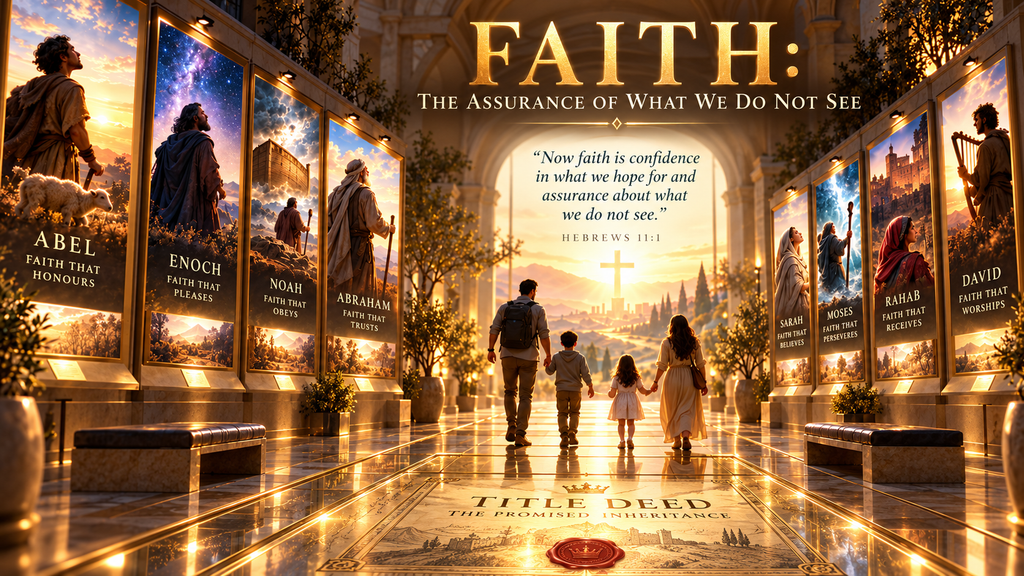
“Now faith is confidence in what we hope for and assurance about what we do not see. This is what the ancients were commended for.” (Hebrews 11:1–2)
I have been chewing on this passage on faith for quite some time now and would love to share what I believe God has been revealing to my heart through this glorious chapter.
There is something profound about the assurance we have through faith, particularly when what God has promised is not yet visible.
The original Greek word translated as faith is pistis, while the word hypostasis in Hebrews 11:1 conveys the idea of assurance, confidence or substance. One helpful illustration of this assurance is a title deed. Just as a title deed provides assurance of ownership, even when the property is not physically before us, faith gives us confidence in what God has promised, even when we cannot yet see its fulfilment.
Hebrews 1:3 uses the word hypostasis in describing the very being or nature of God, which Jesus perfectly represents.
Now, let’s understand what this means for us. Through Jesus, we have a solid foundation for what we believe. We can stand on His Word and His promises with confidence, even when we do not see their fulfilment.
Has God given you a promise through His Word? Then take hold of it through faith in Jesus! Our assurance rests not in what we can see but in the One who has made the promise.
God is faithful to His Word. So we can rest in His assurance!
As we walk through this chapter, I invite you to imagine entering a long gallery. Its walls are adorned with portraits of heroes of faith, each telling a story of someone who trusted God despite uncertainty, difficulty or seemingly impossible circumstances.
As we move from one portrait to another, we discover something beautiful: the same faithful God at work across generations.
And at the heart of this gallery is the unshakeable foundation on which their faith rested, the solid Rock who is Jesus Christ!
Faith in the Power of God’s Word
We read in Hebrews 11:3:
“By faith we understand that the universe was formed at God’s command, so that what is seen was not made out of what was visible.”
What an extraordinary reminder of the power of God’s Word!
The universe itself came into existence at His command. What we see was not made from what was visible.
When we stand on the unshakeable foundation of God’s Word, we can trust His promises even before we see their fulfilment. This is not about imaginary or wishful desires. It is about believing what God has spoken.
Has He given you an assurance from His Word? Then hold firmly to it. Speak His promises with confidence, not because our words have the power to make things happen, but because the God who has spoken is trustworthy.
His character is reliable. His Word is true.
He speaks, and what He purposes comes to pass, even when we cannot yet see what He is doing.
Abel: Faith Expressed Through Reverence and Giving Our Best
The first portrait we encounter is Abel.
Hebrews 11:4 tells us that by faith, Abel brought God a better offering than Cain did.
Think about this for a moment.
Abel brought the firstborn of his flock and their fat portions. He did not simply give God what was convenient or what remained after he had taken care of himself. He offered something precious.
He could have reasoned that the animal would be sacrificed anyway, so why give the best? But Abel chose to honour God with an offering that reflected the reverence of his heart.
His brother Cain also brought an offering. Yet God looked with favour upon Abel and his offering, but not upon Cain and his.
Scripture does not tell us every detail of their motives, but it does draw our attention to Abel’s faith. His offering was more than an outward act. It reflected a heart that trusted and honoured God.
And this is what strikes me.
Both brothers grew up in the same family. Their parents, Adam and Eve, had lived in the Garden of Eden and experienced a relationship with God unlike anything their children would have known.
Imagine the stories they might have told!
Stories of walking with God in the garden. Of His goodness, His holiness and His presence. And also of the terrible consequences of disobedience.
They would have remembered how, even after their sin, God made garments of skin and clothed them. What a remarkable expression of His care!
Abel may well have grown up hearing these testimonies of God’s character.
And although he did not experience life in Eden as his parents had, he chose to honour the God they knew.
His response was one of trusting faith.
He recognised a God who is kind, loving and caring, yet also holy and righteous. And from the depth of his heart, he brought Him his best.
Cain, too, would have heard about this same God. Yet his response was different. Rather than responding humbly to God’s correction, he allowed jealousy and anger to take hold of him, eventually killing his own brother.
Two brothers. The same family history. Yet very different responses to God.
And here we are, thousands of years later, still reminded of Abel’s faith!
His life continues to testify to the importance of approaching God with reverence, trust and a heart that desires to honour Him.
Isn’t it remarkable that an act of worship offered so many generations ago still speaks to us today?
Enoch: Faith That Pleased God Amidst Moral Decay
Now here is where things get really interesting!
According to the genealogies in Genesis, Adam was still alive when Enoch was born. Adam lived for 930 years, and their lifetimes overlapped by several centuries.
Just imagine that!
Enoch lived during a time when Adam himself could still have recounted what life had been like in the Garden of Eden.
The Bible does not tell us whether Enoch personally heard these stories from Adam, but the possibility is fascinating.
Imagine hearing firsthand about fellowship with God in the garden. About His holiness, goodness and faithfulness. About the devastating consequences of sin, yet also His continued care for humanity.
And against the backdrop of a world increasingly affected by sin, Enoch stood out.
Why?
Because he walked with God.
Hebrews 11:5 says:
“For before he was taken, he was commended as one who pleased God.”
What a testimony!
Enoch’s life was marked by faith that pleased God. He trusted Him and walked in fellowship with Him despite the world around him.
His confidence was not rooted in the circumstances of his generation but in the character of the God he worshipped.
What would it mean for you and me to live like that today?
To walk so closely with God that our lives become a testimony of faith in a world increasingly distracted from Him?
Noah: Faith That Held Firm to God’s Faithfulness
The next portrait brings us to Noah.
Noah was born during the lifetime of Methuselah, his grandfather, and Lamech, his father.
According to the chronology in Genesis, Methuselah died in the year of the great flood.
Think of the generations of testimony and history that connected these men!
Noah lived in a world filled with wickedness, yet Scripture tells us that he found favour in the eyes of the Lord.
And when God warned him about things not yet seen, Noah responded in faith.
He built an ark!
Imagine the obedience required to undertake such an enormous task when the catastrophe God had warned about had not yet happened.
Noah could not see the flood. But he trusted the God who had spoken.
He held firmly to that invisible assurance, that “title deed” of faith.
Whether or not Noah heard firsthand accounts about Eden from earlier generations, he chose to trust God’s Word in his own generation.
His faith was not merely an intellectual belief that God existed. It resulted in obedience.
He acted on what God had said.
And through his obedience, God preserved his family.
What a powerful reminder that faith is not passive! Trusting God changes how we live and the choices we make.
Abraham: Faith Passed Down Through Generations
Then comes Abraham.
Here is another fascinating connection.
According to the genealogical chronology in Genesis, Noah and Shem were still alive during Abraham’s early life.
Ancient Jewish traditions suggest that Abraham learned about God from Noah and Shem. While the Bible does not explicitly confirm this, isn’t it fascinating to imagine the possibility?
What if Abraham had heard firsthand about the great flood? About God’s judgement, His mercy and how He preserved Noah and his family?
Noah himself belonged to a long line of generations through which knowledge of God could have been passed down.
And now Abraham enters the story.
He hears God’s call to leave his country and go to a land that God would show him.
And he obeys.
He does not know all the details of what lies ahead. He cannot see the full picture. Yet he trusts the One who is calling him.
Once again, we encounter this invisible assurance.
Faith in a God who can be trusted. A God who is faithful. Whose Word is true. Who is holy, pure and righteous.
And through these portraits, we begin to see a beautiful thread running across the generations.
Each person had to respond to God in faith. They could hear testimonies of His goodness from those who came before them, but ultimately, they had to trust Him for themselves.
And isn’t that true for us too?
We can share our experiences of God’s faithfulness with our children and those around us. But each generation must discover what it means to trust Him personally.
Without Faith, It Is Impossible to Please God
Hebrews 11:6 brings us to one of the central truths of this chapter:
“And without faith it is impossible to please God, because anyone who comes to him must believe that he exists and that he rewards those who earnestly seek Him.”
Now let’s break that down.
The Greek word translated as impossible is adynatos, conveying the idea of something that cannot be done, something beyond our ability.
Without faith, pleasing God is impossible.
Why?
Because coming to Him requires us to believe that He exists and that He rewards those who earnestly seek Him.
This is not simply acknowledging that God is real. It is trusting His character and approaching Him with confidence that He is worthy of our pursuit.
I am reminded of Psalm 42, where the psalmist compares his longing for God to a deer panting for streams of water.
What a beautiful picture of spiritual hunger!
Is your spirit hungry for God like a deer is thirsty for water?
Do you pant after His Word, longing to know more of His truth and His character?
Or do you sometimes find yourself going through the motions, tossed about whenever a challenge comes your way, distracted and running around like a headless chicken with no peace?
I am speaking from experience here!
How easily we can become absorbed by our circumstances and forget the One who holds our lives in His hands.
Yet God invites us to seek Him, to trust Him and to rest in His faithfulness.
Jesus Christ: The Foundation and Fulfilment of Our Faith
My friends, this invisible assurance of faith has been witnessed across generations.
From Abel to Enoch, from Noah to Abraham, and through the countless men and women who trusted God, we see a continuing testimony of His faithfulness.
And today, you and I have the precious privilege of placing our faith in Jesus Christ.
John 3:16 says:
“For this is how God loved the world: He gave his one and only Son, so that everyone who believes in Him will not perish but have eternal life.”
The Greek word translated as believes comes from the same word family as pistis, meaning faith.
But biblical faith is more than a verbal confession or an intellectual nod.
It means trusting Him.
Leaning the entire weight of our lives on Him.
It means running to Him first before turning elsewhere for what we need in life and godliness.
It means relying on His written Word as truth.
It means pressing into Him when life is difficult, and continuing to seek Him even when everything seems to be going well!
This is the faith to which God calls us.
Not a distant acknowledgement of His existence, but a living, trusting relationship with Him through Jesus Christ.
Our Calling: To Live by Faith and Pass It On
Friends, God is calling us today to make a choice.
To choose Him.
To take hold of this assurance of faith and live our lives rooted in His faithfulness.
And to pass on the testimonies of His goodness to those around us.
Tell your family about this God who delights in being relationally involved in our lives.
Tell them about the God who has given us His Holy Spirit to teach us, guide us, warn us, discipline us and point us to Jesus.
Tell them about the God who has equipped us with spiritual armour to stand against the schemes of Satan and his evil forces.
Tell them about the God who sent His precious Son, Jesus Christ, to die on the cross for our sins so that through Him we may have forgiveness, freedom and victory over the power of sin.
Tell them about the God who has generously poured His love into our hearts so that we may love even those who have hurt or maligned us.
Even those we might consider least deserving of our love!
What an extraordinary God we serve!
He has truly given us everything we need for life and godliness.
So today, as we listen to His Word, my prayer is that He will find in you and me hearts filled with deep reverence for Him.
Hearts that choose to put Him first.
Hearts that honour Him with the very best of our time, talents and resources.
And hearts that delight in telling others about His goodness and faithfulness.
May we never forget that the God who sustained Abel, Enoch, Noah, Abraham and countless others is the same faithful God who walks with us today.
A Family Conversation: Passing Faith to the Next Generation
Dear friends, what a precious gift it is that God has preserved these stories of faith for us! Hebrews 11 introduces us to many more heroes, including Sarah, Isaac, Jacob, Joseph, Moses, Rahab, David and others. These were ordinary people who faced real struggles yet chose to trust an extraordinary God.
I encourage you to explore their stories together as family and friends. How did they honour God? What did they learn from those before them? How was faith passed from one generation to the next?
And why not share your own stories of God’s faithfulness? How has He led you, walked with you and revealed His character through life’s joys, challenges and seasons of waiting?
What a wonderful opportunity to help our children recognise His goodness, not only in Scripture but also in our own family histories!
Remember the “title deed” of faith? Just as a title deed assures us of what belongs to us even before we physically possess it, faith gives us confidence in God’s promises, even when we cannot yet see their fulfilment.
Our assurance rests not in what we can see, but in the One who has made the promise.
We cannot believe on behalf of our children, but we can pass on the testimonies of His faithfulness and encourage them to place their own trust in Jesus.
May they too take hold of this precious assurance of faith, make it their own and carry it forward as they walk through life with Jesus.
And may the story of God’s faithfulness continue from one generation to the next!
Prayer: A Life That Honours God
Heavenly Father,
I come before Your throne of grace in awe of all that You have done for me and all that You have given me.
Empty me of myself, of pride, of selfishness and of my constant focus on my own needs, desires and wants.
Help me to be Your hands and feet, and Your voice wherever You take me, so that I may bless those around me and be Your witness in this broken and decaying world.
Father, make every moment of my life count for Your sake.
In Your precious Name, Lord Jesus.
Amen.